
We knew the health of Pope Francis had been declining slowly over the years, so it wasn’t necessarily a surprise when he was hospitalized in February of 2025. It also wasn’t a surprise, however, when he was discharged from the hospital. Throughout his time at Gemelli, my husband and I said to each other, “He’ll bounce back. He always does.” As providence would have it, we happened to be eating brunch across the street from the Vatican as Pope Francis returned home from the hospital, and he drove by us in his little white Fiat. We heard he was instructed to rest, that his public appearances would be limited, if not temporarily suspended. Of course, this didn’t happen. Pope Francis was seen in public a handful of times between March 23 and April 21.
We had a heck of a time attempting to get to Mass at St. Peter’s on Easter Sunday. We wound up listening to Mass from the colonnade, going back and forth on whether or not to leave and find Mass elsewhere later in the day. When Mass concluded, we debated whether or not to stick around for the Urbi et Orbi blessing, which the pope offers twice per year, on Easter and Christmas. “There will be others,” we said. But something urged us to stay, and praised be the Holy Spirit (“something”) that we did. Roman got to see Pope Francis for the second time, Leo was in his presence for the first time, and all of us witnessed and were blessed by him for the very last time.
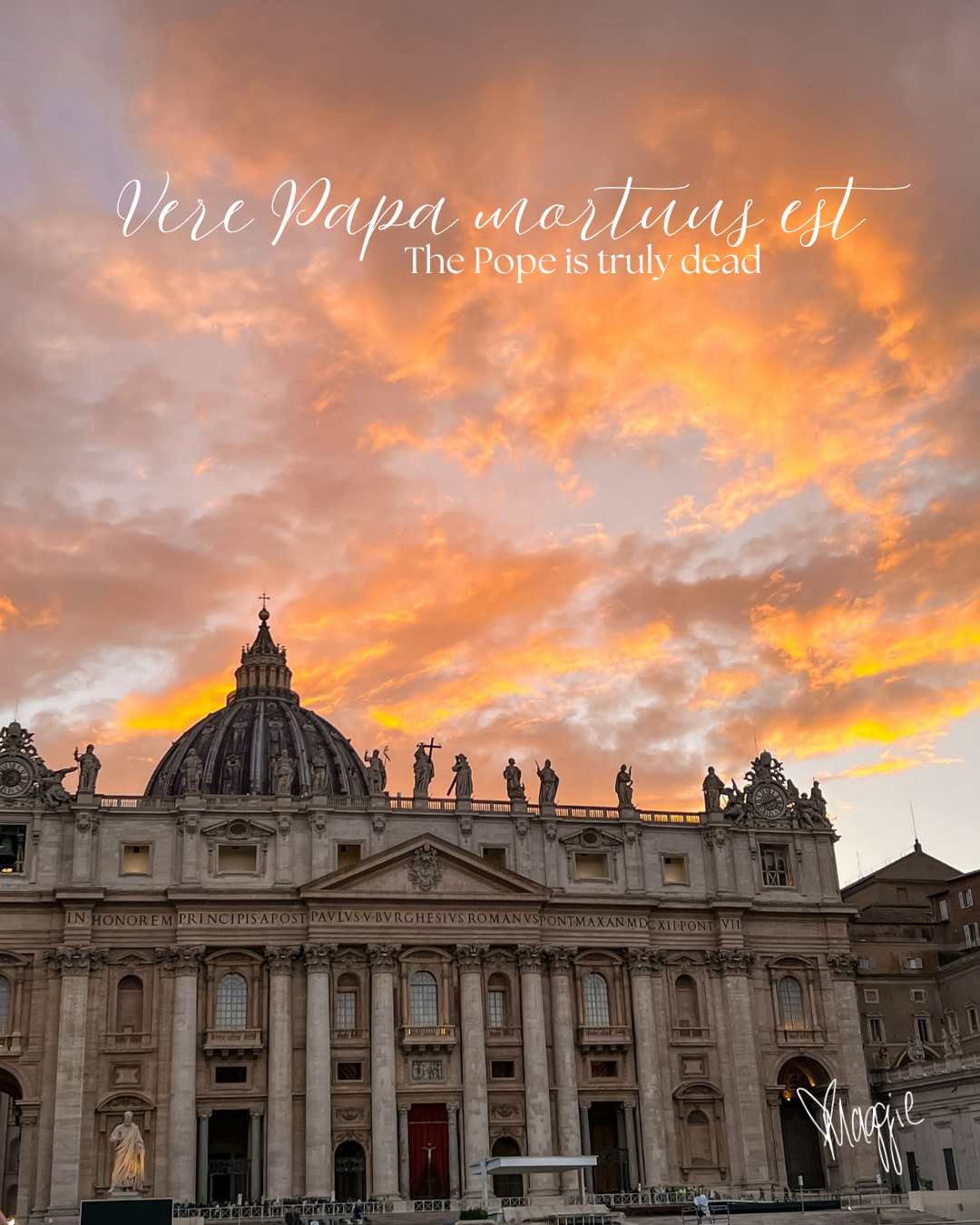
To confirm the death of the pope, the “Cardinal Camerlengo”–who temporarily runs the Vatican during the “sede vacante” (vacant seat) until a new pope is elected–announces, “Vere Papa mortuus est,” which is Latin for “The Pope is truly dead.” Last used to confirm the death of Pope Pius XI in 1939 was the traditional ritual in which the Camerlengo calls the pope by his baptismal name three times. As he did so, he would gently tap the pope’s forehead with a small silver hammer.
Naturally, we were shocked when we heard the news that Pope Francis had passed away the following morning. As fast as we could, we packed up the boys and headed to St. Peter’s Square to pray for the repose of his soul. While we were there, the noon bells rang at the basilica. But instead of the typical Angelus bells, the “death bells” tolled 88 times, for the late pope’s 88 years of life. Tourists continued to shuffle in line through security and into the basilica while we stood in disbelief. We had just seen him yesterday. We were among the last to see him alive. We received his blessing. And now he was gone—in the Octave of Easter, no less! Were we to rejoice or mourn? Both?
Within the week of his passing, we prayed by his body lying in state at St. Peter’s Basilica (and were promptly ushered along as people in front of and behind us attempted to snap pictures of the corpse). A good friend of mine, Leo, and I attended the pope’s funeral–packed with thousands upon thousands of mourners, media personnel, and heads of state. We left early because we couldn’t see or hear anything, but also in order to be able to witness the procession from St. Peter’s Basilica to the Basilica of St. Mary Major, where the pope was to be buried. This was the first time in living memory that a deceased pope wasn’t buried in St. Peter’s, so the procession was sure to be a sight.
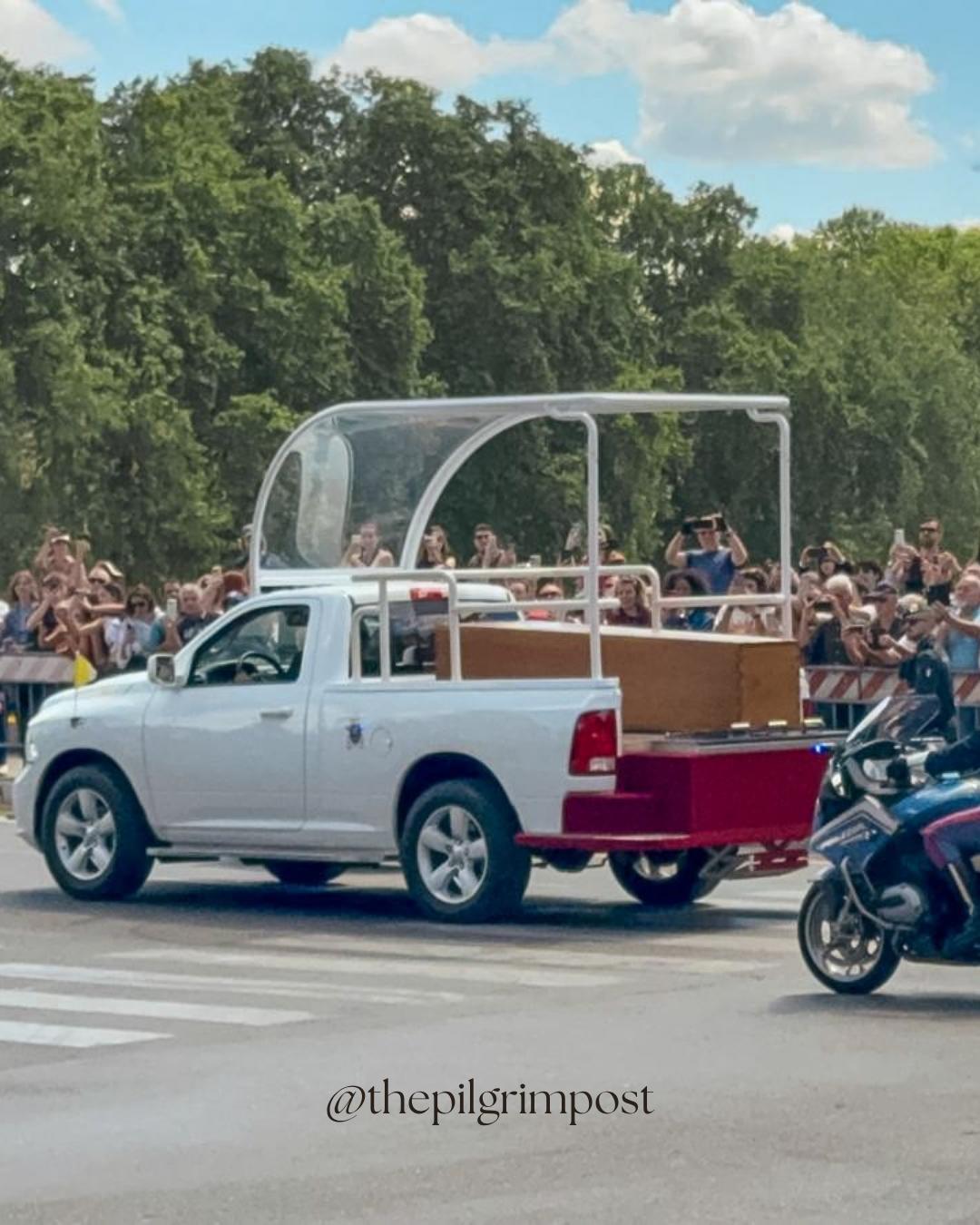
Throughout the week, I experienced a variety of emotions. There was the initial shock and then sadness of losing Pope Francis. Though I had been alive during the reigns of his two predecessors, he was the first pontiff to whom I had really paid attention, and the only one I had the privilege of seeing in person several times. There was excitement–with the death of a pope meant the anticipation of a conclave and papal election. There was anxiety–how on earth were we going to move to and from St. Peter’s Basilica in the coming days and not wear ourselves and the boys out completely? Who would the new pope be? Etc., etc. The gutting feeling of grief was the stand-alone emotion as I stood on the street corner next to my friend, Leo strapped to my chest, and we watched as the truck carrying the casket of the former pope drove from one basilica to the next. That was the moment during which his death finally started to sink in. The death of someone I never knew personally felt absolutely personal because his life was very influential in mine, particularly earlier in his pontificate when I was in high school. I was very moved, in that moment, when speaking with an older woman from California who also stood on the street corner. Due to the noise, I couldn’t hear if she said 15 or 50 years, but she expressed that she had waited a long time to save money and see the pope. There she stood, watching as the pope’s coffin was transported to his final resting place, rather than encountering his jovial smile at an audience.
Everyone is quick to judge public figures, whether they have religious authority, political authority, or whatever kind of authority comes with being famous for its own sake; yet, we’re also quick to forget what we have in common with these people: the fact that we are all humans, created in the image and likeness of God, with inherent dignity and worth. We’re also imperfect and we make mistakes, big and small. Those in the spotlight have the unfortunate reality of their mistakes being broadcast for the world to see. Pope Francis was not immune to public scrutiny throughout his papacy, but it was disheartening to see “Catholic” influencers and the like coming out of the woodwork after his death, not to express mourning over the death of the pontiff, but to express a sort of notion of “good riddance,” without saying so explicitly.
When I was in college, some classmates and I made this joke that essentially said, “Not everything tweeted from the papal bathrooms is infallible.” We could laugh because we knew the concept was ridiculous. Others, apparently, struggled to sort out what was said by Pope Francis that was truly infallible versus when he was speaking in such a way that was easily skewed by those reporting on it, especially if there were any issues with translation from the original language. He had an extraordinary responsibility on his shoulders, and that isn’t something I could begin to fathom what it’s like to carry. There were parts of his ministry that were imperfect–the same has been true for all of the popes throughout history. Pope Francis, at the end of the day, was a shepherd who loved his flock, and he sought to tend the flock in the way that he best knew how. As for the imperfections, I’ll let the pope’s Boss be the ultimate judge of that.
Eternal rest grant unto Pope Francis, O Lord, and let perpetual light shine upon him.